The Supreme Court Keeps Ignoring Actual LGBTQ+ People in Its Gay Rights Cases
- In general
- Apr 03, 2026, 09:45 AM
- By slate.com
- 0 Views
Sign up for Executive Dysfunction, a weekly newsletter that surfaces under-the-radar stories about what Trump is doing to the law—and how the law is pushing back.
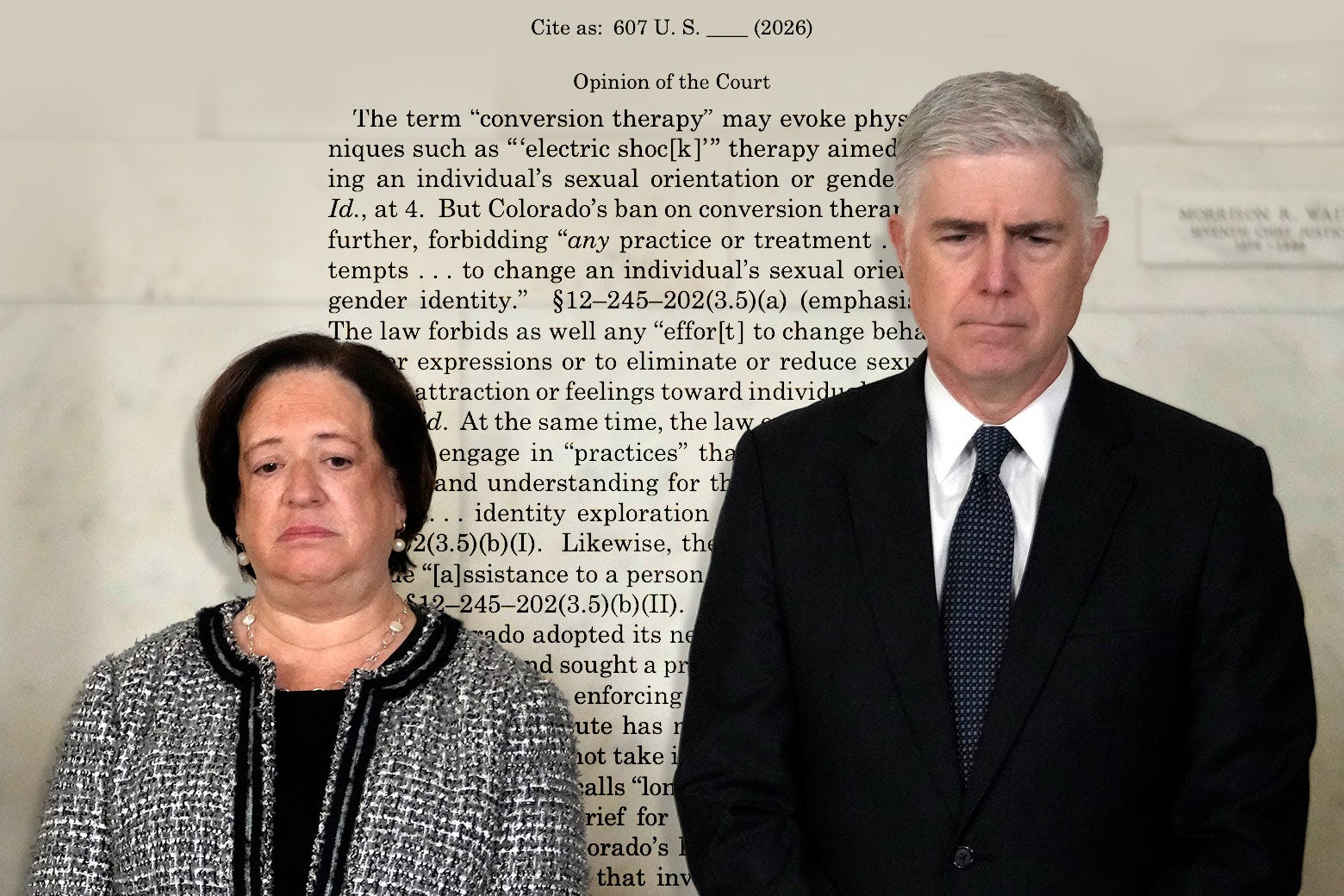
The Supreme Court’s decision in Chiles v. Salazar is painful to anyone who cares about LGBTQ+ adolescents and has either survived so-called conversion therapy or learned about survivors’ experiences. Eight members of the court, six conservatives and two liberals, failed to care. Instead, their sympathy was reserved only for the petitioner before them, a therapist who not only holds the religious view that it is better for minors to avoid being or behaving as LGBTQ+ people, but is also determined to use her therapeutic skills to “help” them live up to this view.
This one-sided empathy is not a spontaneous response to compelling facts, however. It is a result of a skewed litigation design, featuring only the therapist and her nemesis, the state of Colorado, which has banned conversion therapy for minors. When the parties’ briefs were submitted, and later during oral arguments, no one who experienced conversion therapy—which neither converts, nor heals—was there to tell how deeply words can wound. This is because the court took the case in a pre-enforcement posture, before Colorado ever enforced its ban in an actual dispute involving concrete facts and real people who suffered through the “conversion” process. Therefore, no affected person was in the courtroom to refute the therapist’s claim that, since she only deploys speech, her counseling is harmless and deserves First Amendment protection.
By wielding the pre-enforcement strategy in Chiles, the Alliance Defending Freedom replicated its 2023 win in another free speech challenge against the vilified Colorado. In 303 Creative v. Elenis, ADF convinced six conservative justices to allow a web designer to evade antidiscrimination laws and refuse service to same-sex couples. Then, the liberal justices united in a forceful dissent, highlighting the harm imposed on same-sex couples in litigation from which they were excluded. Now, in Chiles, ADF’s strategy swayed even two of the court’s liberals (Justices Elena Kagan and Sonia Sotomayor), despite their previous dissent in 303 Creative. With the exception of Justice Ketanji Brown Jackson, the court was so focused on the therapist’s asserted freedom that it ignored the young patients who would be in her clinic, exposed to her speech, and susceptible to internalizing ideas that may scar them for life.
As predicted, the disregard for LGBTQ+ minors’ well-being produced by ADF’s litigation strategy yielded unfortunate statements that simultaneously minimize the power of uttered words in therapy and inflate the risk of government censorship. Both Justice Neil Gorsuch’s majority opinion and Kagan’s concurrence (joined by Sotomayor) repeatedly follow this pattern. Together, they create a kingdom where speech is royal and nothing else matters.
“All Ms. Chiles does is speak,” writes Gorsuch. Deferring to the therapist’s description of facts, he readily accepts that she does not “seek to impose her values or beliefs on clients,” and instead only “sits down … and talks to them about their goals.” Nowhere is there any critical examination of this framing of distressed children as “clients” holding “goals” of changing themselves. Nor is there a hint of curiosity about how those minors found their way into the clinic of a therapist who holds views supportive of efforts “to reduce or eliminate unwanted sexual attractions” or develop “harmony with [one’s] body.” Never mind that children seldom have meaningful choice but to comply with caregivers’ demands and may be in therapy not to pursue their goals but due to external pressures. And, while enthusiastically embracing the therapist’s narrative, the majority persistently portrays her as a victim of Colorado’s attack on her free speech. The court describes Colorado as a “censorious” regime that “seeks to silence” and “suppress speech based on viewpoint.” It also dismissively rejects the state’s explanation that it solely seeks to regulate its licensed providers to protect its youth from harm—the law only bars licensed medical professionals, and nobody else, from engaging in one particular behavior. It forbids therapists from insisting on spreading their personal views through confidential, sensitive conversations with trusting minors happening behind closed doors.
In her concurrence, Justice Kagan adopts similar themes. What matters, she writes, is “the marketplace of ideas,” and “the case is textbook” because Colorado’s law “distinguishes between two opposed sets of ideas,” only one of which the state approves. Colorado, on this view, “has suppressed one side of the debate,” and engaged in “viewpoint discrimination,” making “the constitutional issue … straightforward.” Again, not a word about the coercive therapeutic context in which vulnerable minors will be subjected to those “ideas” and pressed to implement them. No response to Justice Jackson’s dissent, which reminds the court and the public of a record full of stories and studies demonstrating grave harm. Not an iota of care for Mathew Shurka, “an amicus who received conversion therapy as a child,” who is a living example of the unbearable price paid for framing talk therapy as nothing but speech. As the dissent highlights but everyone else ignores, this talk therapy “brought Mathew nothing but increased isolation from his family, worsening depression, and suicidal ideation.”
Ultimately, reducing the regulation of conversion therapy to a simple matter of free speech in which LGBTQ+ people have no say is a ghastly betrayal of the constitutional duty to protect minorities’ rights and liberties. With its blunt indifference to LGBTQ+ health and dignity, Chiles adds to a growing body of decisions, including U.S. v. Skrmetti, Mahmoud v. Taylor, and Mirabelli v. Bonta, exhibiting dangerous hostility toward queer people.
- business
- Apr 08, 2026, 01:13 PM
- business
- Apr 08, 2026, 01:12 PM
- business
- Apr 08, 2026, 01:12 PM
- business
- Apr 08, 2026, 01:12 PM
- general
- Apr 08, 2026, 01:12 PM
- business
- Apr 08, 2026, 01:12 PM
- general
- Apr 08, 2026, 01:12 PM
- general
- Apr 08, 2026, 01:11 PM
- business
- Apr 08, 2026, 01:11 PM
- general
- Apr 08, 2026, 01:10 PM